Comments from tutors: Think about in your design: Relationship with other parts f the building; how it relates to the glass wall and the roof above... does it go up or down to the upper/lower level? Will it provide a way for people to move between the floors, or let them communicate with (each) other(s)?
With the idea of deformation, will other people, eg. business students, who aren't 'related' to design understand that it isn't something new that you've created, but rather a materail of the existing that you've deformed? Really get into the details; if it's the glass you're deforming, pay attention ot the material of the glass - how it's joined, the rubber silicon used... so you can compare it to the original existing fabric to know it's changed... etc. Eg. a scrunched up piece of paper compared to a normal flat piece of paper
Even playing with visibility - can see a denser area when there are more layers of the design.. don't see anything/you see right through it if there's just that one pane...
(Judy): How many of you are dealing with education...? How does your space take on the issues... generating knowledge is what university's about. Space of creativity is also a space of learning
Even where we're locating the designs, it could be anywhere because it's in atriums etc.
Unchallenging, very safe...
Talk, trade, come away with an idea you like...
topdocumentaryfilms.com - the virtual revolution
There's no right idea and very few good ideas... just generate...
Friday, October 1, 2010

Inhabit 2: Continuing with my design...
So this is what happened after talking to the tutors:
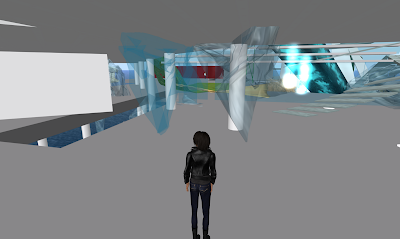
To start off with, i changed the texture of my sculptie to match the already existing glass panel made by JboshOC pegasi so at least you can tell it's of the same material. You can see the difference in the image above. (The piece to the right probably won't be there in the end, but i just left it there at this stage to compare the difference in textures.
My sculptie has also been remarked by one of my tutors that it looks like a sort of mesh, as opposed to my wanting it to look like bits of fragmented glass. That wasn't a very good comment, i thought, so i'm now looking at going back to making separate prims to really get that straight, cut-out shapes to make the fragmented glass-look more convincing.
Below shows a starting attempt to make a piece that makes the glass wall look more broken up...
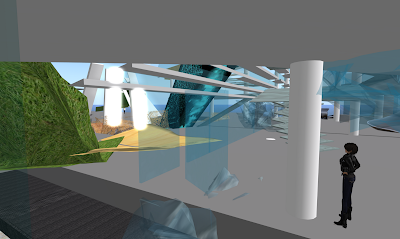
I am also looking at making more sculpties in 3ds max to save the number of prim-usage.

To start off with, i changed the texture of my sculptie to match the already existing glass panel made by JboshOC pegasi so at least you can tell it's of the same material. You can see the difference in the image above. (The piece to the right probably won't be there in the end, but i just left it there at this stage to compare the difference in textures.
My sculptie has also been remarked by one of my tutors that it looks like a sort of mesh, as opposed to my wanting it to look like bits of fragmented glass. That wasn't a very good comment, i thought, so i'm now looking at going back to making separate prims to really get that straight, cut-out shapes to make the fragmented glass-look more convincing.
Below shows a starting attempt to make a piece that makes the glass wall look more broken up...

I am also looking at making more sculpties in 3ds max to save the number of prim-usage.
Thursday, September 30, 2010
Inhabit 2: Start of design...
To begin, i decided to use 3ds max to make a sculptie that embodies my idea of deformation and fragmentation, as i didn't want to use too many prims (since we have a limit of about 150 already, for all of us). One thing i was concerned about was the fact that it would turn out a bit more curved, rather than showing the individual triangles that make up the entire shape shown in 3ds max. Nevertheless, i decided to proceed and see what the sculptie would turn out to look like in Secondlife... you'll never know unless you try, right...
So... this is what it turned out to look like (the picture may be a bit small...)

It did turn out to look a bit more curved that i would have liked, but i guess it's a start.
So... this is what it turned out to look like (the picture may be a bit small...)

It did turn out to look a bit more curved that i would have liked, but i guess it's a start.
Inhabit 2: Notes
Matt Ridley: Who knows how to make a computer mouse? no one. No one person knows how to make the entire thing...
(last part of the talk) can go beyond our capacity... how well we can communicate our ideas and how well we're co-operating
interchanging of ideas
Architecture = ? Technology... just adding information
understand relationship between these things... not just information in building somehow but information in the process somehow...
TED TALK: Clay Shirky: How cognitive surplus will change the world.
Making life better for everybody...
we are what we celebrate
Be aware of not just the students but also the staff etc.
Design... generosity
Think about the individuals... their motion, stopping to talk... something we need to tap into
How do you get the people that enter into the building to engage in some sort of generous act... etc.
(last part of the talk) can go beyond our capacity... how well we can communicate our ideas and how well we're co-operating
interchanging of ideas
Architecture = ? Technology... just adding information
understand relationship between these things... not just information in building somehow but information in the process somehow...
TED TALK: Clay Shirky: How cognitive surplus will change the world.
Making life better for everybody...
we are what we celebrate
Be aware of not just the students but also the staff etc.
Design... generosity
Think about the individuals... their motion, stopping to talk... something we need to tap into
How do you get the people that enter into the building to engage in some sort of generous act... etc.
Tuesday, September 28, 2010
Inhabit 2: Notes
Brief notes taken in the 3-hour design slots... just for my own noting, so it may not make much sense to you, whoever is reading this...
TED TALK: Matt Ridley
exchange of ideas - more specialisation, more exchanging...
Even though someone is better at both things, it is still better to let someone else... and specialise in one thing..
TRADE AND COLLABORATE
scratch4sl
http://web.mit.edu/~eric_r/Public/S4SL/
installation on designboom - interaction
eg. pust a button and the elevator comes down etc.
reactive architecture - interesting but may also affect... eg. sliding dorrs, never touch the building - don't touch the architectrue...
Whe we inhabit, occupy, it's about leaving something behind
What opportunity are you going to take... of the building?
small installation, some sort of moment that clearly illustrates what your ideas are. Like a quick sketch
gold ruberg machine - Adam Sadowsky engineers a viral music video
no property boundaries... think of how it all blends together
TED TALK: Matt Ridley
exchange of ideas - more specialisation, more exchanging...
Even though someone is better at both things, it is still better to let someone else... and specialise in one thing..
TRADE AND COLLABORATE
scratch4sl
http://web.mit.edu/~eric_r/Public/S4SL/
installation on designboom - interaction
eg. pust a button and the elevator comes down etc.
reactive architecture - interesting but may also affect... eg. sliding dorrs, never touch the building - don't touch the architectrue...
Whe we inhabit, occupy, it's about leaving something behind
What opportunity are you going to take... of the building?
small installation, some sort of moment that clearly illustrates what your ideas are. Like a quick sketch
gold ruberg machine - Adam Sadowsky engineers a viral music video
no property boundaries... think of how it all blends together
Monday, September 27, 2010
Inhabit 2: Introduction
As a continuation of the previous project, i decided to remain in the same space (cafe seating area of the oggb) for this one and further develop my idea of deformation.
Tuesday, September 21, 2010


Subscribe to:
Posts (Atom)